
I might be wrong - but...
25 May ‘26 issue
I believe that if we spend 1% to 3% of our business revenue on insurance and risk reduction, then every business person should spend 3% of their time looking at the catastrophe scenarios and thinking them over. Whom is prepared, may adapt. Diversion:
This is amusing – given that the inevitable logic of capitalist consumption-driven global warming is a fact, the Germans may have sorted out the whole ocean logistics challenge in a most creative (and accidental) way: https://www.abc.net.au/news/2026-05-23/tasmania-iceberg-breaks-away-with-shipping-containers-on-board/106710726 Come on, click the link, it’s safe!
Digression:
I’m a bit late this month with the blog, but I have a most excellent reason. Here in Georgia (the USA one) our primary election this year was on the 19th of May. I was called to help work one of the polling stations – you too can be a poll worker! Democracy works best for the people when the people work the democracy. And if you have any scepticism about the election process, you’ll learn more in the hours of training and then working a few times than you will ever learn from the various windbags and self-serving punditry of the influencer class.
When I had an editor, he regularly cut up my run on sentences. Think of that as an intellectual ramble with a few extra fun words that are just begging for a chance to shine.
When you work the polls, you are present from the start of the process to the end, from the time the machines are unlocked till they are packed right back up. This is because we are all present together the whole time and are thus completely and honestly able to testify to the whole team’s integrity and the events of the day. In this case our location was fundamentally secure, so we could do the gross setup the day ahead, by which I mean that we move everything into location and run power cords, make sure there are chairs and tables to work at, and so forth.
I don’t know how it works in other states. Here we stop the setup once the boxes of voting machines and the mass of signage is positioned and security checked. Nothing is unlocked – the voting machines are not just locked, but have serialized security seals on them. It is the “day of” when everything happens. Starting before six in the morning (05:45h) we gather, are sworn in as agents, and then have an hour to open up, set up, connect, power up, test, test again, and then run pre-use reports on every device. Our location had ten of us working, 12 voting stations, and 5 checkin systems. This is 2026, yes of course it’s all computerized. And of course it has citizenship databases, et cetera, etc.
This is not mentioned as part of any participation in any of the various voting conspiracy theories.
I mentioned we set up before oh-dark-thirty. We continue running the polls until seven in the evening (19:00h) when we mark the end of the line and only those already in place get to vote. Whew! But we aren’t done, because after the last voter leaves we take down all those signs. Run all the scrips on all the machines to get ballot counts (not the votes, just the number of ballots cast), tally up all the output tapes from each of the machines, check the maths – in total there are at least six different totals from the various bits of machinery and their outputs, and they ALL must agree.
That’s when we get to start shutting down and packing up everything. Not before all the data has been collected redundantly, the printed cast ballots are counted and secured in a witnessed lock box, lots more et cetera and lots more security seals checked, applied, and so forth.
In our case we rolled out at ten fourtyfive-ish (22:45h) which by my basic math means we the people each worked 17 continuous hours with only the shortest of breaks (in which we were not to leave the assigned voting area). Our manager had another hour to return key bits and machines and ballots and get all of that witnessed and audited a few times more at the HQ.
And THAT is why this blog is a bit late this month. I’ve survived enough trips around the sun to need sleep, and to recover badly in the absence of said slumber. But now you also know something about how this gets done, because statistically you had no idea whatsoever of how voting in the USA Actually Works.
The Actual Topic: Intersecting long term trends
I’m writing this essay to share an intersection of long term trends that I find fascinating and terrifying in equal measure: a look at longer horizons and global scope, not the usual collection of short information sources and simple analysis. I’ve been reading on the long term risk/opportunity at the intersection of demographics and climate change. These are very entangled. Here are a few thoughts.
We are in a very chaotic situation right now with the rolling effects of the Iran War; these will continue for at least a couple of years even if the Strait of Hormuz opens tomorrow – and that’s intersecting with what is already the hottest year in history with a historically severe El Niño likely this fall. These will not interact well.
Starting with the demographics in a nutshell, at four time points. At the top of the chart is historical data and then the bottom are current best projections. I wish the circles were scaled for total population (in order: 2.5, 7.5, 9.8, and 10 billion respectively according to the UN). That huge population jump from 1950 to 2015 might be causative for the Millennial and Gen-Z basket of complaints about the boomers - boomers grew up in a simpler time and a smaller world that was preternaturally calm.
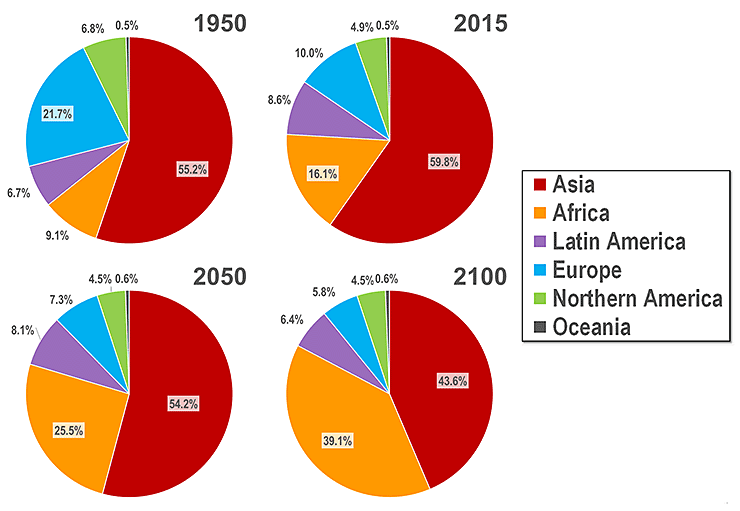
Global population as a percentage at key time points
Big picture: Africa’s population is young and growing rapidly. The chart shows population as percentages, remember that by 2050 there will be a few **billion** more people alive. As for Asia’s population, the growth is almost entirely in the Indian Sub-continent. Japan, South Korea, China – all of them are shrinking with ever falling birth rates and aging populations.
Consider first the miserable demographic situation in all the ‘developed’ economies. Japan, China, South Korea, all of Western Europe, and now the USA all have a problem – aging populations. These shrinking nations in the developed world *could* decide that they want a lot of immigration so that their senior population has a care team. We can see how well that works by looking at politics and cultures in Europe, USA, China, and Japan – immigration is being restricted and small local experiments in selective admissions are problematic. I’ll touch on that a bit more in just a bit.
Relatedly, there is a population boom in Africa, and unlike China the demographics in India are pretty good for future growth. So Africa generally and India and Bangladesh and Afghanistan specifically have much younger and rapidly growing populations. See below, a lovely chart from the UN.
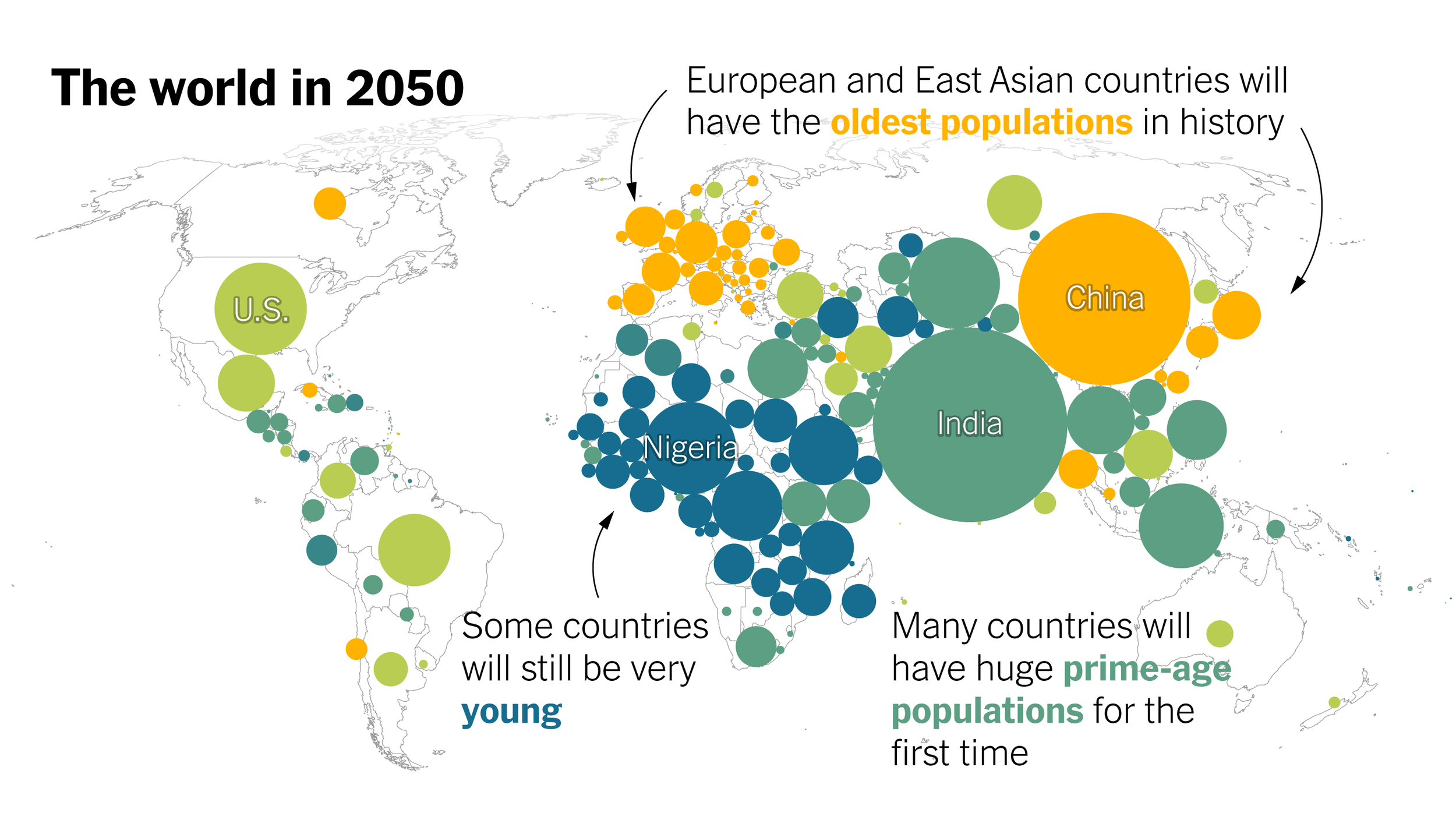
Projections for 2050 (neglects possible WW3)
Yay! Potential workers for the developing economies. For that to lead to economic development you need: educated workers – and the capital to enable them to make productive economic contributions. India is doing pretty well on the education part, with some issues. Africa is very situational, some nations are pushing hard, most of the others are trapped in ongoing post-colonial warfare and/or desperate poverty.
But this intersects with the growing chaos caused by global warming. The areas that are already having really bad disruptions and which are expected to get much worse are the ones with the rapid population growth: Africa (especially West and North) and the Indian sub-continent. So a country that is experience chronic and worsening weather disasters and already works with a tight budget is somehow supposed to focus on the development of their people and infrastructure while dealing with cycles of drought and famine and floods that immiserate much of their population.
And over the next 25 years, that is going to be where over one half of all humans live. Meanwhle the developed nations, for all their wealth, will be burdened by an increasingly old population that was promised health care and retirement in relative comfort. Angry old people voting hasn’t worked out well lately, turns out the fuzzy nostalgia and fantasy are lousy ways to prepare for an uncertain future.
We are already seeing the first symptoms of disruptions emerge from the cataclysmic weather, fertilizer prices spiking, newly hot great powers competition, and in those developing nations there are ever increasing populations of angry youths with internet access and little else.
Not to mention the threats of AI to economic and political stability in the developed nations.
By way of an analogy, remember that the trigger for the “Arab Spring” was a spike in fertilizer prices followed by a spike in basic food prices. https://en.wikipedia.org/wiki/Arab_Spring That is still playing out in Syria, Libya, and so on 15 years on. The refugees from the chaos increasingly fled to Europe, triggering quickly a backlash and the rise of ultra-right parties. So we aren’t going to solve our demographic cliff problem with immigrants, are we?
Right now fertilizer prices are higher than they were then, and the weather is unpredicable with floods and drought destroying crops, and the chaotic conditions in North Africa are worse than they were in 2010 (much of it in consequence).
Expect chaos, this is historically unprecedented. These are situations where nations self-destruct and wars become endemic – human history does not suggest that in times of crisis the powers in control will cooperate.
I’ve not even scratched the surface, this little essay is written in the hope that you will take a few minutes and look out five and ten years and challenge all your assumptions about how you will make decisions and adapt when the future just keeps getting scarier. As chaotic as business has been in the last year, someday we will all look back at 2025 and 2026 and think of them as the good ol’ days.
I’m just afraid that the rate of decay is going exponential.
Seriously – we get very limited information in the USA about what is going on in the rest of the world (except for the big news crisis of the day, of course). You have to make the time to search for knowledge.
References:
https://www.uneca.org/stories/17-out-of-the-20-countries-most-threatened-by-climate-change-are-in-africa%2C-but-there-are “Currently, 17 out of the 20 countries most threatened by climate change are located in Africa and climate change already impacts 2 to 9 percent of national budgets across the continent.”
https://www.aljazeera.com/opinions/2026/5/22/india-is-being-left-to-die-in-the-heat The URL has the lead point - India’s corrupted government is doing all the wrong things, and the deaths from heat increase steadily.
https://cdkn.org/west-africa This drill down on West African is edifying. And the site lets you see other regions. This is a great source for information on projects and resources for adaptation, as well as reports from all over the world.
https://www.ifrc.org/nota-prensa/deadly-heatwave-sahel-and-west-africa-would-have-been-impossible-without-human-caused Temperatures about 120 degrees Fahrenheit with high humidity are not survivable.
https://www.carbonbrief.org/climate-change-made-west-africas-dangerous-humid-heatwave-10-times-more-likely/ Similar to the above article but with some additional information. For giggles, use your search tool of choice and ask it about the recent heat waves in the USA and how those are also exacerbated by global warming.
https://news.un.org/en/story/2025/05/1163126 Climate change takes increasingly extreme toll on African countries – and the places getting hit the worst now are surprisingly where you find the most political chaos and suffering. Many millions of internal migrants in Africa are in desperate conditions.
https://www.downtoearth.org.in/climate-change/indias-climate-apocalypse-new-scientific-update-paints-stark-picture-on-countrys-accelerating-crisis Heat kills so many people.
Summary: Well, there you go. I’m your agent of sunshine and cheer, as always.